
Motivators—What Drives People to Create an Estate & Crypto Plan
Trust & Will's 2025 Estate & Cryptocurrency Planning Report reveals key motivators and trigger events that drive individuals to create their estate and cryptocurrency planning documents.

By Maya Powers
Estate & Cryptocurrency Planning Content Expert, Trust & Will
Estate planning is often perceived as a process reserved for the wealthy, but the data reveals a far more universal motivation: love, responsibility, and peace of mind. While financial security is a factor, people are primarily driven to create an estate and crypto plan to protect their loved ones and ensure their wishes are honored.
The Top Motivators
Among the respondents who already have an estate and crypto plan, the two most cited reasons were peace of mind for the unexpected (50%) and protecting loved ones (50%)
These responses significantly outweigh financial motivators such as providing financial security for heirs (34%) and avoiding probate (29%). Even fewer respondents cited minimizing tax liability (14%) or desire to leave a lasting legacy (15%) as key reasons, further reinforcing that estate and cryptocurrency planning is primarily about ensuring stability for loved ones, not wealth preservation.
While charitable giving (7%) and employer-provided estate and cryptocurrency planning benefits (7%) ranked among the less common reasons for creating an estate and crypto plan, these numbers highlight an important opportunity. A meaningful percentage of individuals are already motivated by philanthropy and workplace benefits, signaling room for growth as more organizations prioritize estate and cryptocurrency planning as part of financial wellness initiatives. As awareness increases and accessibility improves, charitable giving and employer-sponsored estate and crypto plans could become even more significant drivers of estate and cryptocurrency planning adoption.

The Role of Family: Parents Prioritize Protection
The presence of children significantly impacts estate and cryptocurrency planning decisions. Parents—especially those with children both over and under 18—are the most likely to prioritize estate and cryptocurrency planning. 62% of parents cite protecting loved ones as their primary motivator, exceeding the overall average of 50%, and 44% cite financial security for heirs and beneficiaries, again significantly surpassing the overall average (34%).
For parents, estate and cryptocurrency planning is not optional—it is a necessary safeguard for their children’s well-being. The trend is even more pronounced for those planning to have children in the future, who place greater emphasis on accessibility, with 16% citing workplace benefits and 18% citing cost savings as primary motivators. This highlights the growing demand for affordable, employer-sponsored estate and cryptocurrency planning solutions among younger individuals preparing for parenthood.
Life Events as Triggers: What Prompts People to Take Action?
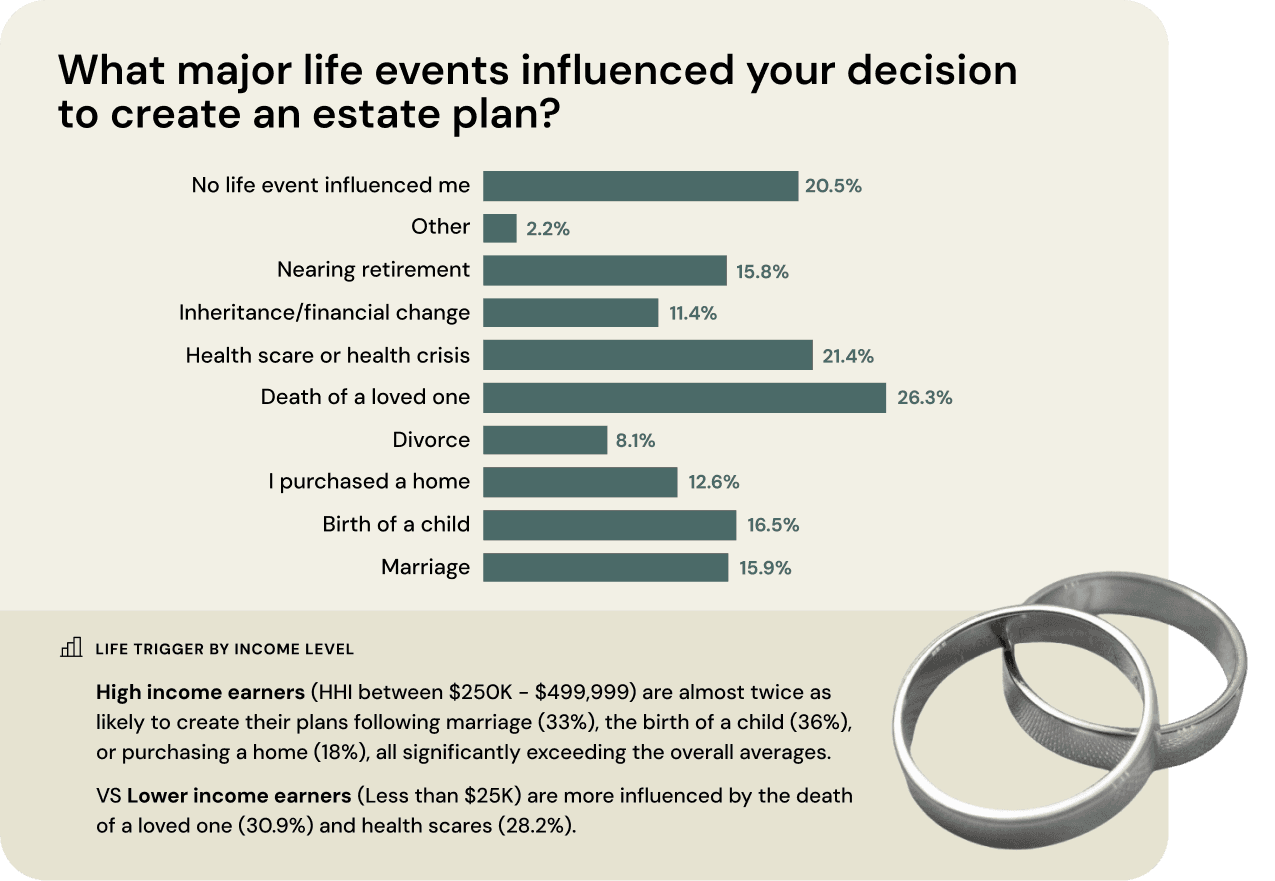
While estate and cryptocurrency planning is often framed as a proactive decision, the data suggests that many people only take action after experiencing a major life event. The most common life event that prompted respondents to create their estate and crypto plan was the death of a loved one (26%)
Other key triggers include:
Health scare or crisis (21%)
Birth of a child (17%)
Marriage (16%)
Nearing retirement (16%)
Purchasing a home (13%)
Inheritance or other financial event (11%)
Notably, 1 in 5 respondents (21%) reported that no single life event influenced their decision, suggesting that some individuals take a proactive approach to estate and cryptocurrency planning, while others wait for a crisis or major milestone before acting.
Generational Differences: Crisis vs. Milestone Planning
Estate planning triggers vary significantly across generations. Younger generations (Gen Z and Millennials) are more likely to create estate and crypto plans after major life milestones, such as:
Marriage (25% of Millennials, 22% of Gen Z)
Birth of a child (27% of Millennials, 23% of Gen Z)
Purchasing a home (19% of Millennials, 22% of Gen Z)
These findings indicate that younger respondents view estate and cryptocurrency planning as a tool for future security rather than an immediate necessity. Older generations (Silent Generation and Baby Boomers), in contrast, are more reactive, often creating estate and crypto plans after a personal or family crisis:
Death of a loved one (25% of Baby Boomers, 20% of the Silent Generation)
Health scare (18% of Baby Boomers, 17% of the Silent Generation)
Inheritance or financial windfall (25% of Silent Generation, 23% of Baby Boomers)
This generational contrast suggests that older adults may not consider estate and cryptocurrency planning until they experience firsthand the complications of managing an estate.
Income and Estate & Cryptocurrency Planning: Financial Stability as a Trigger
Interestingly, estate and cryptocurrency planning motivations also shift based on household income. Higher-income households ($250,000–$499,999) are nearly twice as likely as the overall population to create estate and crypto plans following marriage (33%), the birth of a child (36%) and purchasing a home (18%).
This suggests that for wealthier individuals, estate and cryptocurrency planning is often a proactive financial strategy tied to long-term wealth management. Lower-income households (under $25,000), on the other hand, are more influenced by the death of a loved one (31%) and Health scares (28%)
For these respondents, estate and cryptocurrency planning appears to be a reactive decision driven by loss or financial vulnerability rather than proactive financial planning.
Education’s Influence on Estate & Cryptocurrency Planning Triggers
Education level also plays a key role in estate and cryptocurrency planning behavior. Death of a loved one is the most significant trigger across all education levels, but particularly among those with less than a high school education (40% vs 26% overall) and individuals with some college, no degree (31% vs 26% overall).
Marriage and birth of a child are more likely to prompt estate and cryptocurrency planning among those with a bachelor’s degree (19% and 17%) and a doctorate (23% and 19%)
This suggests that individuals with higher education levels may view estate and cryptocurrency planning as part of long-term financial planning rather than a reaction to life events.
Racial Differences in Estate & Cryptocurrency Planning Triggers
Racial demographics further highlight how different communities approach estate and cryptocurrency planning. Native respondents are significantly more likely to be influenced by purchasing a home (37%) and the death of a loved one (42%). While Asian respondents were the only racial group to cite marriage as their top motivator (28%) even over death of a loved one (22%).
These findings suggest that historical and cultural values play a role in shaping estate and cryptocurrency planning priorities, with Native respondents reacting more to financial security and Asian respondents placing greater emphasis on family structure.
Surprisingly, estate and cryptocurrency planning is rarely driven by financial gain—it is a deeply personal decision rooted in love, responsibility, and major life events. Parents, in particular, place the highest importance on protecting loved ones and ensuring financial security for heirs. Younger generations are more likely to be influenced by cost and convenience, while older generations often take action only after experiencing a crisis. The data reinforces that estate and cryptocurrency planning is not just about managing wealth—it is about preparing for the unexpected, safeguarding loved ones, and ensuring one’s wishes are honored.
These insights were unveiled in the groundbreaking 2025 Trust & Will Estate & Cryptocurrency Planning Report—the largest estate and cryptocurrency planning survey ever conducted. Click here to view the full report.
Trust & Will is an online service providing legal forms and information. We are not a law firm and we do not provide legal advice.
Last updated: March 20, 2026


Related Articles
View All Articles
Estate & Cryptocurrency Planning - 8 min read
Will vs Trust - What’s The Difference & Which Option is Right for You?

Financial Advisors - 3 min read
What Advisors Would Rename Make-A-Will Month

Estate & Cryptocurrency Planning - 5 min read