
Barriers—Why Don’t People Have an Estate & Crypto Plan?
Trust & Will's 2025 Estate & Cryptocurrency Planning Report reveals the key barriers that prevent Americans from planning their estates, despite knowing its benefits.

By Maya Powers
Estate & Cryptocurrency Planning Content Expert, Trust & Will
Despite the clear benefits of estate and cryptocurrency planning, the majority of Americans remain unprepared. The data reveals that a combination of perceived irrelevance, procrastination, financial concerns, and knowledge gaps prevent many from taking action. However, the reasons for inaction vary across income, education level, and racial groups, highlighting the behavioral and systemic barriers that shape estate and cryptocurrency planning decisions.
The Biggest Barriers: Perceived Irrelevance, Procrastination, and Cost
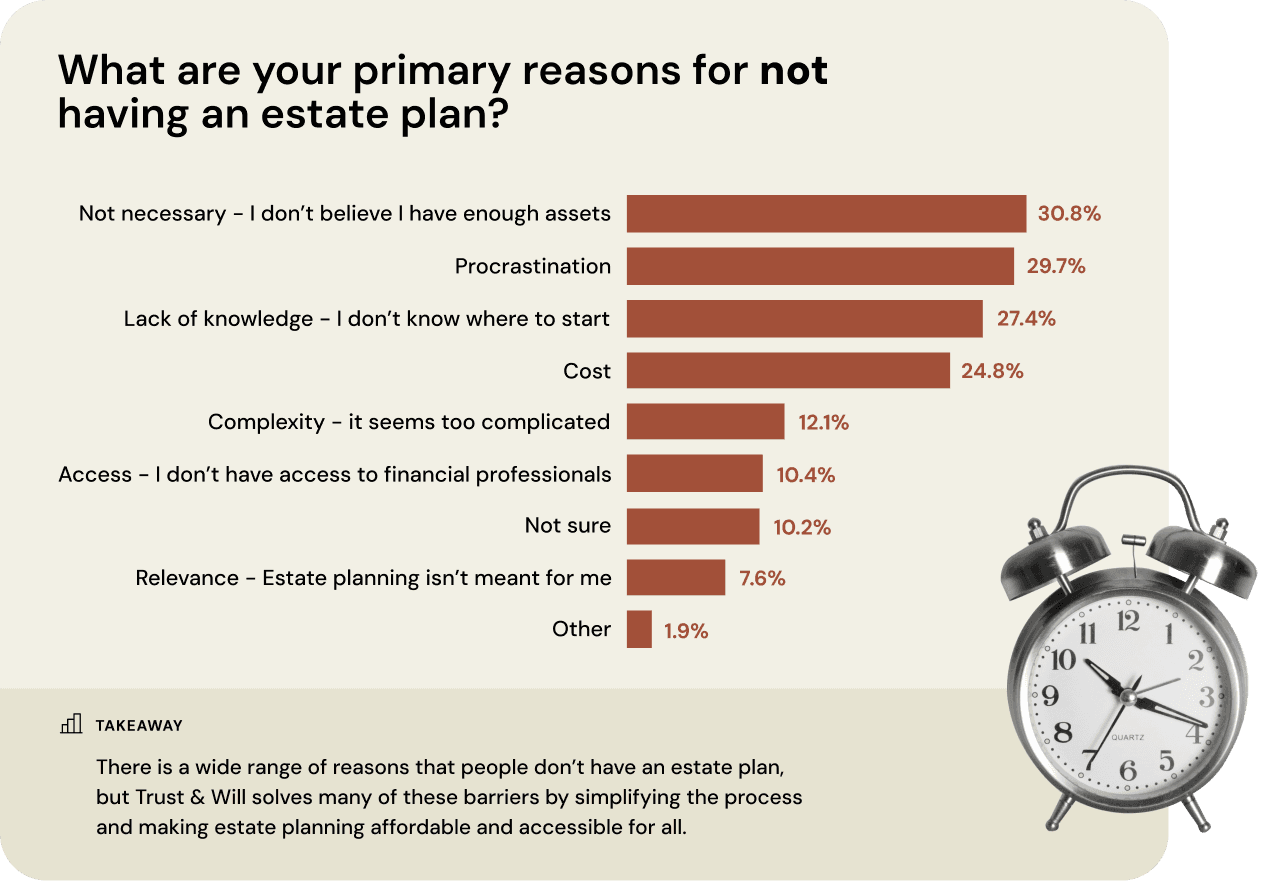
Among the respondents without any estate and cryptocurrency planning documents, the most common avoidance reasons are:
“Not necessary—I don’t believe I have enough assets to warrant an estate and crypto plan” (31%)
“Procrastination—I haven’t gotten around to it yet” (30%)
“Lack of knowledge—I don’t know where to start” (27%)
“Cost—I think it’s too expensive” (25%)
These responses highlight a fundamental challenge: many Americans still perceive estate and cryptocurrency planning as something only for the wealthy, rather than a necessary tool for protecting their wishes and loved ones. The procrastination factor suggests that even those who understand estate and cryptocurrency planning’s importance struggle to prioritize it until it becomes urgent—a risky approach that can leave families unprotected in times of crisis.
The Role of Income and Education: Who Puts It Off, and Who Feels Left Out?
Income and education level play a defining role in shaping estate and cryptocurrency planning attitudes. Higher-income households ($150,000+) overwhelmingly cite procrastination as their top barrier, with 44% saying they “haven’t gotten around to it yet.” This makes these respondents 83% more likely to blame procrastination compared to lower income households (24%).
Lower-income households (under $50,000) are significantly more likely to believe estate and cryptocurrency planning is unnecessary. 33% cite “I don’t have enough assets to warrant an estate and crypto plan,” compared to wealthier households, where this misconception is far less common.
Education level follows a similar pattern. Those with a master’s or doctorate degree are the most likely to cite procrastination as their reason for inaction (49%), while individuals with a high school education or less are far more likely to believe estate and cryptocurrency planning simply “isn’t necessary” (29%).
These findings reinforce the psychological and financial divide in estate and cryptocurrency planning adoption. Higher-income and highly educated individuals recognize estate and cryptocurrency planning’s importance but often deprioritize it, while lower-income and less-educated individuals are more likely to believe estate and cryptocurrency planning isn’t relevant to them, perpetuating a cycle of inaction.
Racial Differences: Knowledge Gaps vs. Procrastination
As made evident across all the data, barriers to estate and cryptocurrency planning also vary significantly by race, with some groups struggling more with knowledge gaps while others simply put it off.
Asian (43%) and biracial (38%) respondents are far more likely to cite “lack of knowledge” as their primary reason for not having an estate and crypto plan, nearly twice as high as white respondents (26%) who cite the same reason. This suggests that education and accessibility gaps may be larger barriers in some minority communities.
White respondents, by contrast, are the most likely to say they’re simply procrastinating (33%) or that they don’t believe they have enough assets (32%)—even though they are more likely than other racial groups to actually have estate and cryptocurrency planning documents.
Black and Hispanic respondents fall in the middle, facing both knowledge gaps and accessibility concerns. They are less likely than white respondents to cite procrastination (25% and 20%, respectively) but are more likely to cite access as a major barrier. 12% of Black respondents and 13% of Hispanic respondents saying they don’t have access to trustworthy legal or financial professionals — 39% higher than the average. This suggests that, for these groups, estate and cryptocurrency planning is not just about awareness or financial readiness, but also about navigating systemic barriers to professional guidance.
The Tipping Point: What Moves People from Inaction to Action
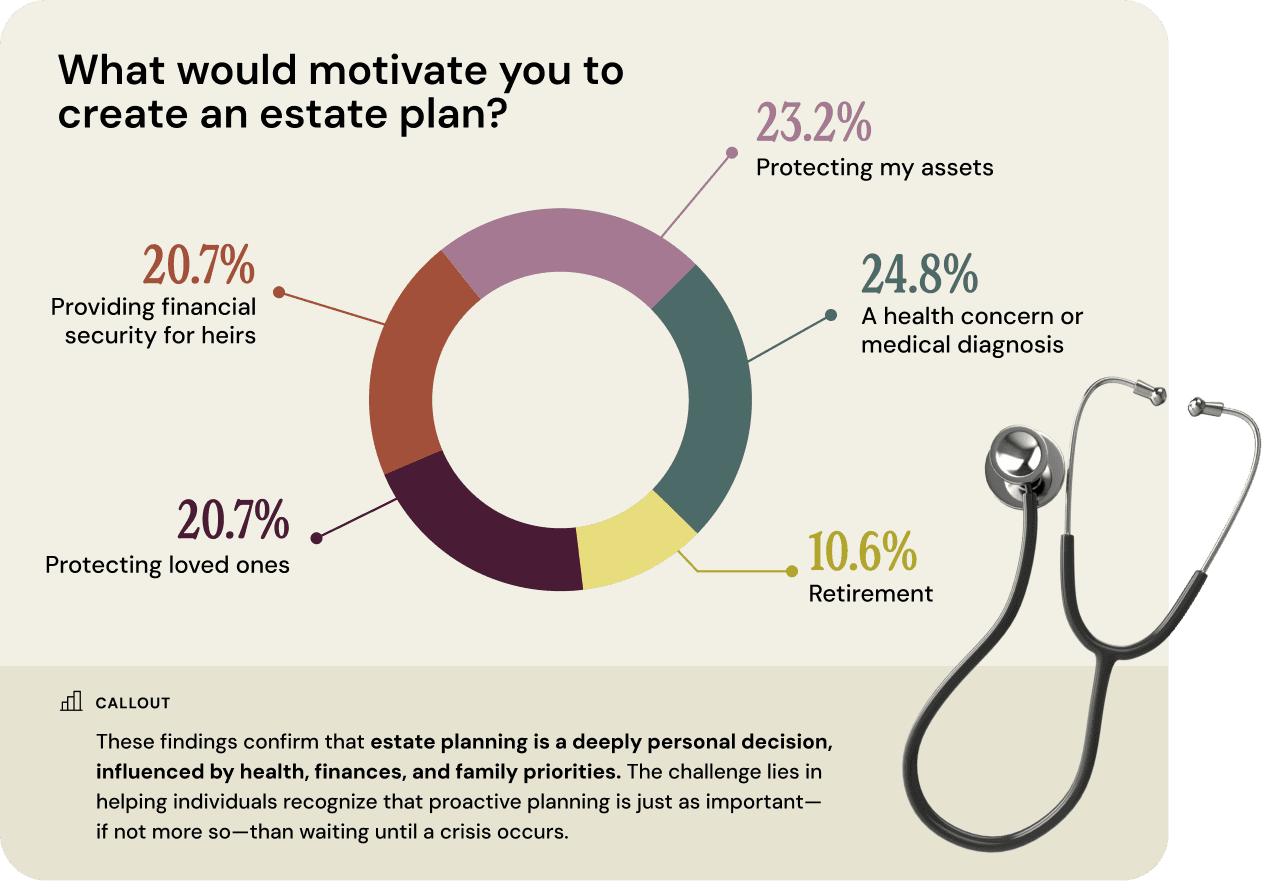
While barriers are significant, the data also reveals what would push non-planners to take action. When asked, “What would motivate you to create an estate and crypto plan?” the most common responses were:
A health concern or medical diagnosis (25%)
Protecting my assets (23%)
Protecting loved ones (21%)
Providing financial security for heirs (21%)
These findings reinforce that estate and cryptocurrency planning is often driven by life events rather than proactive decision-making.
Demographic Trends: Different Priorities Across Age, Income, and Gender
Older generations (Silent Generation & Baby Boomers) are primarily motivated by probate avoidance (28% and 22%) and health concerns (25%). This aligns with the reality that many older adults only begin estate and cryptocurrency planning when it becomes an immediate necessity.
Younger generations (Millennials & Gen Z), on the other hand, prioritize protecting assets (26%) and ensuring financial security for heirs (23%). They are also the most interested in workplace estate and cryptocurrency planning benefits (14% and 15%), signaling an opportunity for employer-provided solutions.
Higher-income households ($500,000–$999,999) prioritize protecting assets (67%) and minimizing tax liabilities (33%). In contrast, lower-income households (under $25,000) are far more likely to be motivated by health concerns (21%) and protecting loved ones (17%). This suggests that for wealthier individuals, estate and cryptocurrency planning is viewed as a financial tool, while for lower-income individuals, it is a protective necessity.
Men and women also differ in their top motivators. Women are most likely to be motivated by health concerns (26%), while men prioritize protecting their assets (26%).
These findings confirm that estate and cryptocurrency planning is a deeply personal decision, influenced by health, finances, and family priorities. The challenge lies in helping individuals recognize that proactive planning is just as important—if not more so—than waiting until a crisis occurs.
Overcoming Barriers and Closing the Estate & Cryptocurrency Planning Gap
The reasons Americans don’t have estate and crypto plans are as varied as the reasons they eventually create them. While some lack knowledge, others lack financial resources or access—and for many, estate and cryptocurrency planning simply feels like a “later” task. The data, however, paints a clear picture: those who wait until later often wait too long.
Addressing these barriers requires better education, accessibility, and proactive messaging. For lower-income and less-educated individuals, emphasizing the affordability and necessity of estate and cryptocurrency planning can help dispel the myth that it is only for the wealthy. For procrastinators, reframing estate and cryptocurrency planning as a way to protect loved ones today—rather than something to put off indefinitely—could be key to closing the gap.
These insights were unveiled in the groundbreaking 2025 Trust & Will Estate & Cryptocurrency Planning Report—the largest estate and cryptocurrency planning survey ever conducted. Click here to view the full report.
Trust & Will is an online service providing legal forms and information. We are not a law firm and we do not provide legal advice.
Last updated: March 20, 2026


Related Articles
View All Articles
Estate & Cryptocurrency Planning - 8 min read
Will vs Trust - What’s The Difference & Which Option is Right for You?

Financial Advisors - 3 min read
What Advisors Would Rename Make-A-Will Month

Estate & Cryptocurrency Planning - 5 min read