Confidence vs. Action: The Estate & Cryptocurrency Planning Paradox
Trust & Will's 2025 Estate & Cryptocurrency Planning Report reveals an interesting paradox between Americans and their understanding of estate and cryptocurrency planning versus taking action.

By Maya Powers
Estate & Cryptocurrency Planning Content Expert, Trust & Will
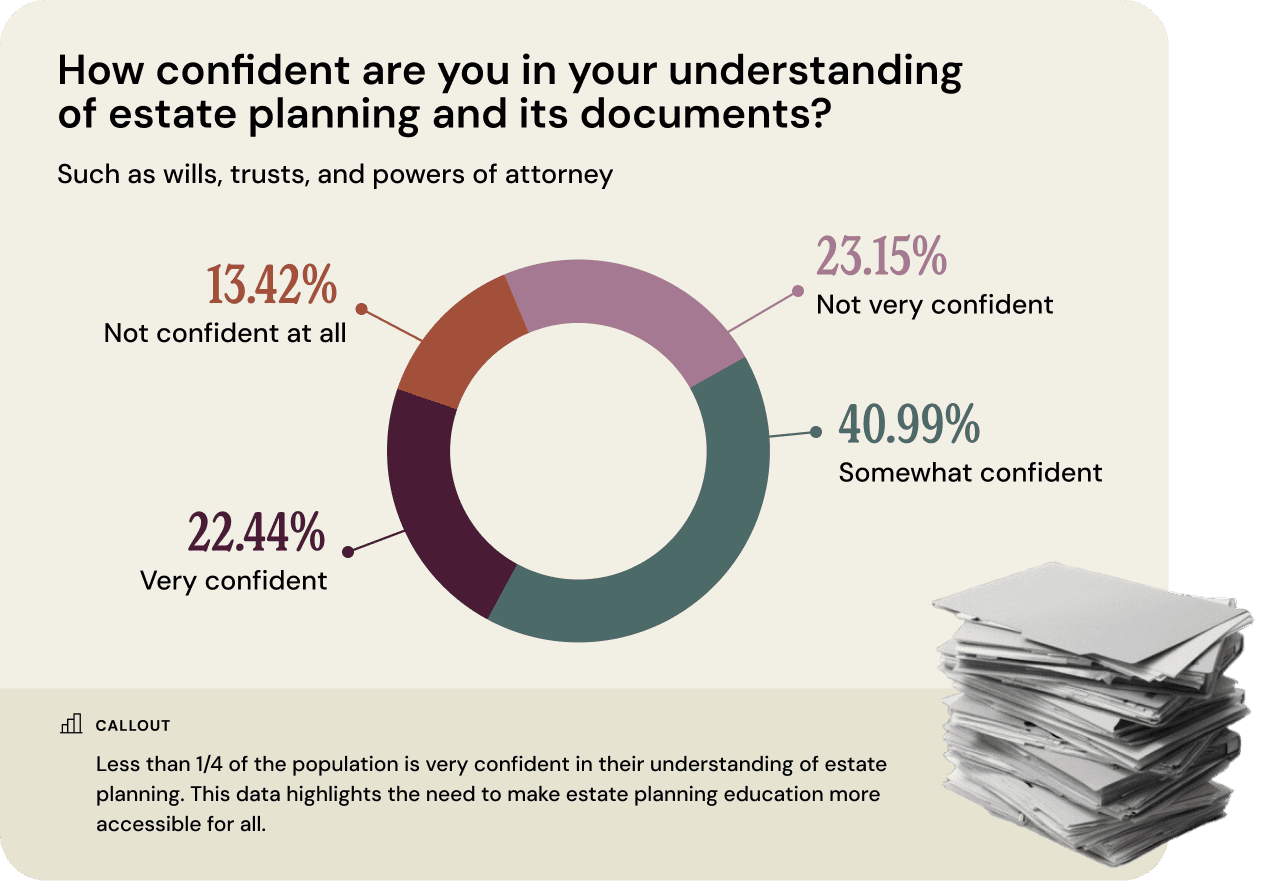
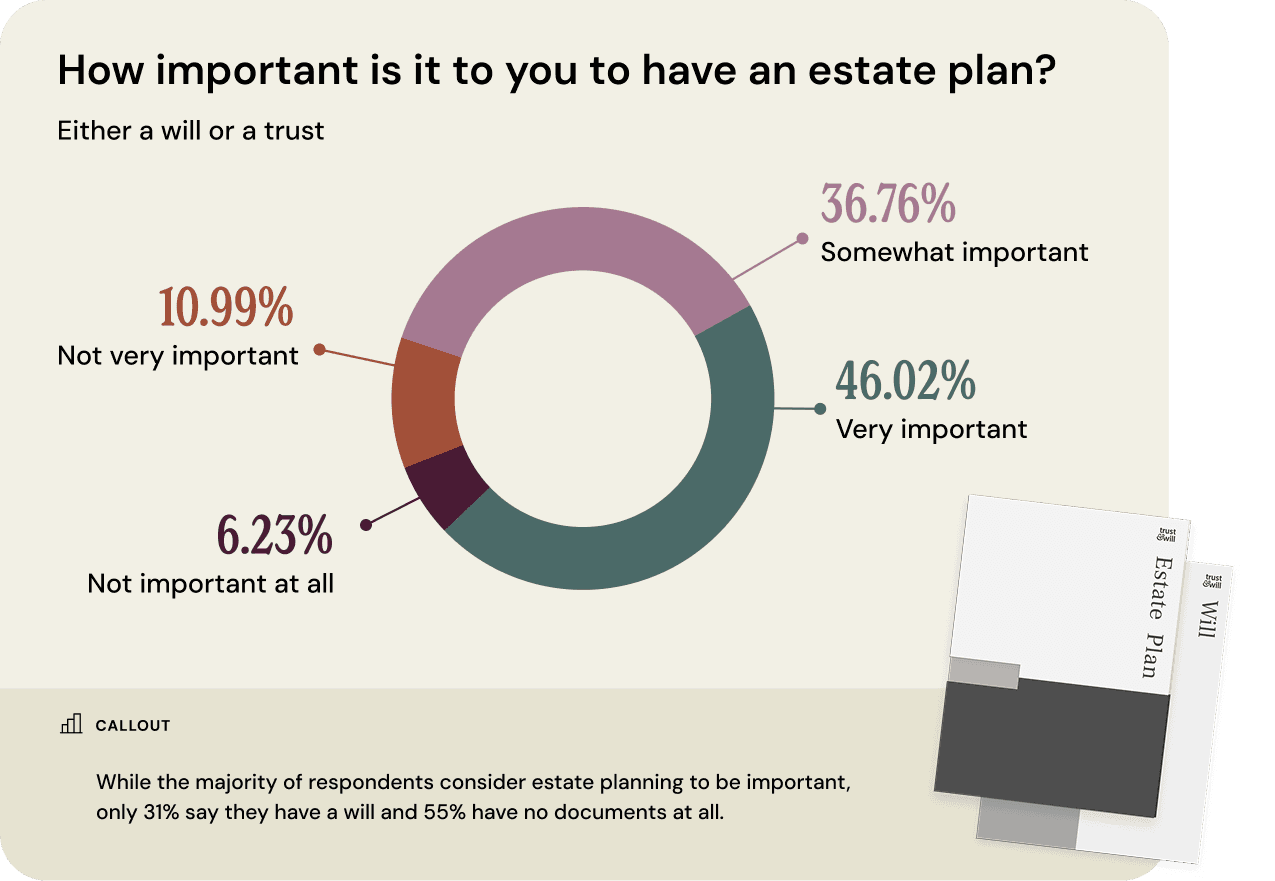
As we’ve seen, estate and cryptocurrency planning is widely acknowledged as important, yet many Americans remain unprepared. A significant portion of the population expresses confidence in their understanding of estate and cryptocurrency planning, but this confidence does not always translate into action. The data reveals a stark contradiction—while many individuals believe they know enough about estate and cryptocurrency planning, they still lack the necessary legal documents to protect their assets and loved ones. This gap between perceived knowledge and actual preparedness underscores a critical issue: estate and cryptocurrency planning is not just about awareness, but about taking concrete steps.
Do Americans Really Understand Estate & Cryptocurrency Planning?
Confidence in estate and cryptocurrency planning knowledge varies significantly by demographics, with certain groups expressing high levels of self-assurance despite having little or no actual preparation in place. Education plays a key role—respondents with a doctorate or higher were the most confident, with 34% stating they feel “very confident” in their understanding of estate and cryptocurrency planning. In contrast, only 18% of those with less than a high school degree reported the same. Interestingly, confidence in estate and cryptocurrency planning knowledge increases with every level of education, even though actual estate and cryptocurrency planning adoption does not always follow the same trend.
The Confidence vs. Preparedness Gap
One finding the data continues to show is that knowledge does not necessarily translate into action. While some groups express confidence in their estate and cryptocurrency planning knowledge, many still fail to take the necessary steps to secure their legacy.
Education plays a major role in this gap. Individuals with higher education levels are significantly more likely to claim confidence in estate and cryptocurrency planning—yet they are also more likely to procrastinate.
Among those with a doctorate or master’s degree, procrastination is the top reason for not having an estate and crypto plan—with 52% and 45% of respondents, respectively, admitting they have simply put it off.
Conversely, those with a high school diploma or less are more likely to say estate and cryptocurrency planning is unnecessary—34% of these respondents cited a lack of perceived relevance as the reason for not creating an estate and crypto plan.
This paradox is also evident in racial differences. Black and Hispanic respondents report higher confidence in estate and cryptocurrency planning knowledge than white respondents, despite lower rates of adoption.
30% of Black respondents and 28% of Hispanic respondents say they feel ‘very confident’ in their knowledge, compared to only 21% of white respondents.
Additionally, 51% of Black respondents say estate and cryptocurrency planning is ‘very important,’ exceeding the 46% of white respondents who say the same.
Yet 64% of Black respondents and 62% of Hispanic respondents have no estate and cryptocurrency planning documents, compared to 52% of white respondents.
This data highlights an intriguing contradiction: while Black and Hispanic respondents are more likely to report confidence in their understanding of estate and cryptocurrency planning, white respondents are more likely to have taken action by creating wills or other documents. It could suggest that systemic barriers could be inhibiting action for minority groups
Even high-income earners fall victim to estate and cryptocurrency planning inertia. Those making $250,000–$499,999 per year were the most likely to cite procrastination (62%) as their primary reason for not having an estate and crypto plan. This underscores that estate and cryptocurrency planning is not just about financial resources—it is often a matter of behavioral psychology. Many individuals recognize its importance yet hesitate to take action until a major life event forces their hand.
The confidence-preparedness gap is further reflected in how often people update their estate and crypto plans. Even among those who do have an estate and crypto plan, many fail to keep it current. Younger respondents, particularly Gen Z and Millennials, are more likely to update their estate and crypto plans frequently—
33% of Gen Z updates annually
13% of the Silent Generation updates annually.
This suggests that younger individuals may be more aware of the need for ongoing estate and cryptocurrency planning, even if they are less likely to have a plan in place to begin with.
The key takeaway is clear: awareness and confidence alone do not guarantee action. While estate and cryptocurrency planning knowledge is essential, the data suggests that behavioral patterns, systemic barriers, and psychological roadblocks prevent many Americans from following through—even when they acknowledge its importance.
Probate Awareness: A Knowledge Gap with Consequences
Probate—the court-supervised process of settling an estate after death—is a core element of estate and cryptocurrency planning. Yet awareness of probate varies dramatically by both generation and income level.
Older generations are significantly more familiar with probate than younger ones. The Silent Generation is 93% more likely to understand probate than Gen Z. Only 1% of the Silent Generation reported being unfamiliar with probate, compared to 14% of Gen Z respondents, who admitted they “don’t know what probate is at all.”
Income plays an equally significant role in probate awareness. Lower-income respondents are twice as likely to be unfamiliar with probate compared to higher-income individuals. Among those earning less than $25,000 per year, 14% stated they don’t know what probate is, compared to just 6% of those earning over $1M.
These knowledge gaps highlight a major challenge in estate and cryptocurrency planning: even among individuals who are aware of probate, many fail to plan ahead, leaving their estates vulnerable to the costly and time-consuming probate process.
These insights were unveiled in the groundbreaking 2025 Trust & Will Estate & Cryptocurrency Planning Report—the largest estate and cryptocurrency planning survey ever conducted. Click here to view the full report.
Trust & Will is an online service providing legal forms and information. We are not a law firm and we do not provide legal advice.
Last updated: March 20, 2026


Related Articles
View All Articles
Estate & Cryptocurrency Planning - 8 min read
Will vs Trust - What’s The Difference & Which Option is Right for You?

Financial Advisors - 3 min read
What Advisors Would Rename Make-A-Will Month

Estate & Cryptocurrency Planning - 5 min read