
Estate & Cryptocurrency Planning & Financial Advisors: A Missing Piece or a Separate Service?
70% of consumers believe estate and cryptocurrency planning belongs in financial planning. Here’s why advisors can’t afford to overlook this growing client expectation.

By Maya Powers
Estate & Cryptocurrency Planning Content Expert, Trust & Will
Financial advisors guide their clients through some of life’s most complex financial decisions—investment strategies, retirement planning, and risk management. But should that guidance extend to estate and cryptocurrency planning? According to our study, the majority of consumers say yes — and that shouldn’t come as a surprise.
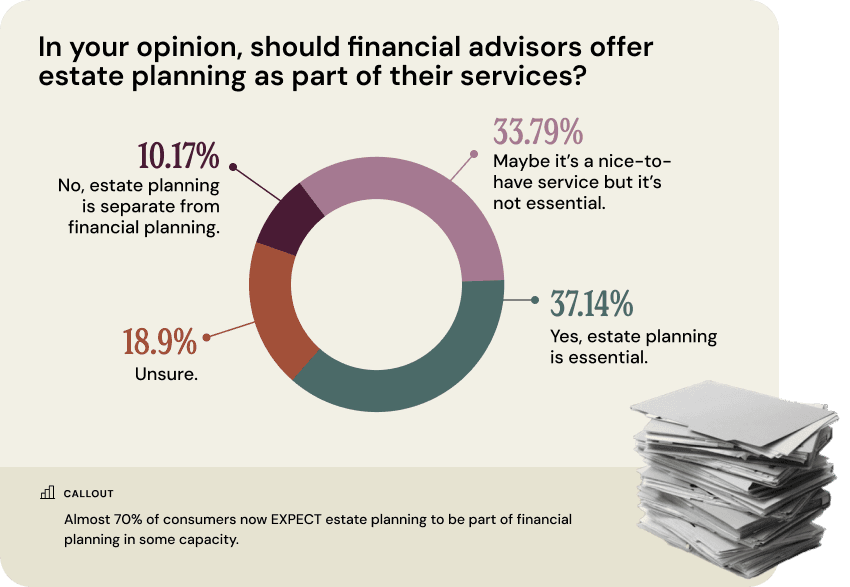
Trust & Will’s 2025 Annual Estate & Cryptocurrency Planning Report found that a staggering 83% of Americans believe estate and cryptocurrency planning is very important. Yet, despite this overwhelming acknowledgment of its significance, most individuals have not completed an estate and crypto plan. Given this gap between awareness and action, it’s no surprise that 70% of consumers now expect estate and cryptocurrency planning to be part of financial planning in some capacity:
37% believe it is essential for a complete financial plan.
33% say it’s a “nice-to-have” but not necessary.
Only 10% believe estate and cryptocurrency planning should remain entirely separate.
These findings underscore a significant shift in client expectations. Estate planning is no longer seen as just a legal matter—many clients now view it as a natural extension of financial advising.
Estate & Cryptocurrency Planning Demand by Demographics
While overall demand for estate and cryptocurrency planning services is high, some groups place a greater emphasis on it than others.
Younger generations, often seen as less engaged in estate and cryptocurrency planning, are actually leading the demand for integration. 40% of Millennials and 39% of Gen Z said estate and cryptocurrency planning is essential to financial planning. These numbers closely track with Gen X (38%), suggesting that clients of all ages expect their advisors to offer estate and cryptocurrency planning guidance.
Income plays a major role in estate and cryptocurrency planning expectations. Among those earning less than $25K, only 28% said estate and cryptocurrency planning is essential. However, among those earning over $500K, 55% believe it should be included as a core part of financial planning.
One unexpected finding emerged among high-net-worth clients—those earning over $1M were more likely to say estate and cryptocurrency planning should remain separate (19%) than any other income group. This suggests that ultra-high-net-worth individuals may already have established relationships with estate attorneys and prefer to keep these services independent from their financial advisors.
Political & Geographic Trends
Political affiliation had minimal impact on estate and cryptocurrency planning attitudes, though Libertarians (44%) were the most likely to support estate and cryptocurrency planning integration. This aligns with previous findings showing that Libertarians are also more likely to work with financial advisors in general.
Geographically, support for estate and cryptocurrency planning integration was strongest in the Northeast (39%), while the Southeast (34%) had slightly lower levels of agreement. These minor regional differences suggest that estate and cryptocurrency planning expectations are relatively consistent across the country.
Education, Gender & Racial Differences
Education levels strongly correlate with estate and cryptocurrency planning engagement. Those with higher levels of education were significantly more likely to say estate and cryptocurrency planning should be part of financial advising. Conversely, respondents with lower education levels were the most likely to say they were unsure—indicating a knowledge gap in estate and cryptocurrency planning awareness.
A gender divide also emerged. Men (40%) were slightly more likely than women (36%) to say estate and cryptocurrency planning should be part of financial advising, while women (21%) were more likely than men (15%) to say they were unsure. This could suggest that estate and cryptocurrency planning conversations need to be framed differently to engage female clients more effectively.
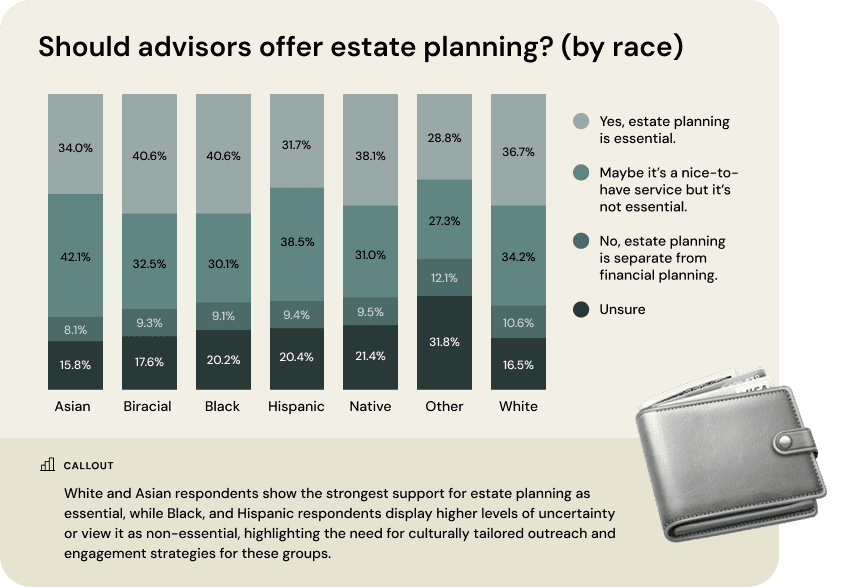
Racially, Biracial (40%) and Black (40%) respondents were the most likely to believe estate and cryptocurrency planning should be integrated into financial planning. This is particularly interesting when compared to data from previous estate and cryptocurrency planning studies, which show that Black and Native American respondents often express high confidence in estate and cryptocurrency planning knowledge but are among the least likely to have estate and cryptocurrency planning documents. This suggests that while these groups recognize the importance of estate and cryptocurrency planning, barriers to access still exist.
A Major Opportunity for Financial Advisors
The data is clear: Estate planning is no longer viewed as a stand-alone legal service—it’s an expectation within financial planning.
For financial advisors, this presents a major opportunity to:
Differentiate their services by offering estate and cryptocurrency planning guidance.
Deepen relationships with clients by addressing long-term wealth preservation.
Capture new clients—especially among younger generations, high-income individuals, and underrepresented demographics who are actively looking for estate and cryptocurrency planning support.
Financial advisors who fail to incorporate estate and cryptocurrency planning into their client conversations may find themselves at a disadvantage. While 70% of clients believe estate and cryptocurrency planning belongs in financial planning, many advisors have yet to integrate it into their services. As estate and cryptocurrency planning becomes an industry expectation, those who embrace it will strengthen client trust, differentiate themselves from competitors, and build a more comprehensive financial advisory practice.
These insights were unveiled in the Trust & Will 2025 Annual Financial Advisor Report. Click here to view the full report.
Trust & Will is an online service providing legal forms and information. We are not a law firm and we do not provide legal advice.
Last updated: March 20, 2026


Related Articles
View All Articles
Financial Advisors - 3 min read
Introducing Our Newest Financial Advisor Contributor Panel

Financial Advisors - 3 min read
What Advisors Would Rename Make-A-Will Month

Financial Advisors - 3 min read